Type 2 diabetes? This discovery may explain why your blood sugar levels are still not under control.
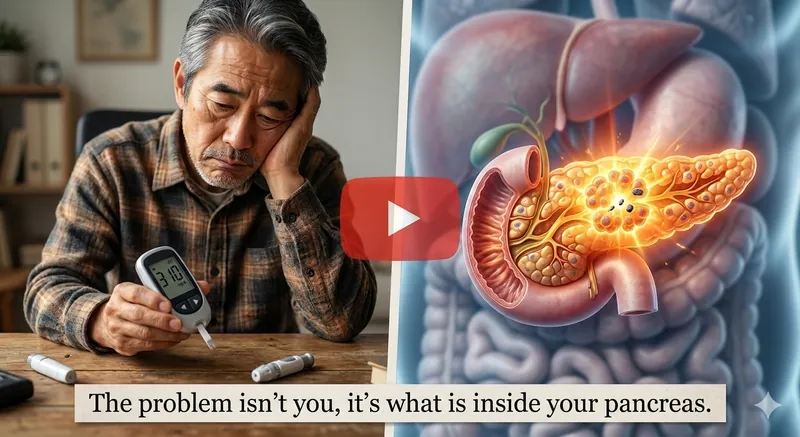 Watch the Video and See What Researchers Found
The Pancreatic Connection — What Researchers Have Been Investigating
Your problem may not be just what you eat. Something happening inside your pancreas could be part of the picture.
Researchers studying pairs of siblings — one with type 2 diabetes, one without — have looked at why, despite shared genes, family environment, and similar habits, only one sibling developed the disease.
One area of ongoing investigation involves biological factors inside the pancreas that may interfere with the beta cells responsible for producing the hormone that helps regulate blood sugar.
This biological factor doesn't just sit inside the pancreas — it may interfere with the beta cells responsible for producing GLP-1, the hormone that helps your body regulate blood sugar. When GLP-1 production is disrupted, insulin can become less effective. Diet changes alone don't always address this. Standard treatment often focuses on managing the symptom rather than this underlying factor.
GLP-1 is the same hormone that billion-dollar popular injectable drugs attempt to artificially replicate — at $1,500 a month, with a long list of side effects. But if the root cause is still active inside your pancreas, even those drugs only mask the problem temporarily.
Some researchers have also looked at how modern diets heavy in pesticides and processed food chemicals may affect the immune system — creating conditions that could make it harder for the body to maintain healthy blood sugar regulation on its own.
The encouraging part: there's a natural approach that may help support this process. It costs less than one dollar. And it has been used in one region of Japan for generations.
Does Any of This Sound Familiar?
You cut out sugar. You take your medication every day. And your numbers are still climbing.
You followed every instruction. You gave up the foods you love. You tried diets that left you exhausted and miserable. And still — at your next appointment, the results are the same or worse.
You were told it might be genetic. But your siblings don't have it. You were told to exercise more. You did. Nothing changed. You start to wonder if something inside you is simply broken beyond repair.
Diabetes Doesn't Just Damage Your Body — It Takes Over Your Life
The emotional weight is something no lab result captures. People with uncontrolled blood sugar aren't just managing a condition — they are living inside a prison they didn't build:
- The anxiety of eating at a restaurant and not knowing what's safe.
- The exhaustion of counting every carb and still seeing the wrong number.
- The frustration of doing everything right and watching your A1C go up anyway.
- The shame of feeling like your own body turned against you.
- The fear of what comes next — amputations, blindness, kidney failure.
- The helplessness of watching medication costs pile up with no end in sight.
If any of this feels familiar, you are not failing. There is a biological reason this keeps happening — one that has nothing to do with your effort — and it has only recently started receiving attention from researchers.
People Who Found Out About This Before You Did
Thousands of Americans have already started incorporating the Japanese morning habit described in the video below into their daily routine.
Dr. Attia has devoted years of his professional career to researching the causes of type 2 diabetes and the dietary patterns of the six regions of the world with the lowest rates of the disease — the Blue Zones. What he discovered in Okinawa, Japan, changed everything.
In Okinawa, people eat pasta, rice and bread every day. However, only 5 in every 100 people have high blood sugar levels — compared with 36 in every 100 in the United States. The difference was not genetic. It was linked to a specific compound found in a rare honey produced only in that region, combined with three natural ingredients which, together, can help promote healthy GLP-1 production. This presentation brings together these findings in a practical and accessible format.
If You Have Any of These Symptoms, Pay Close Attention
These are some common signs that your body's blood sugar regulation may benefit from extra support:
- Excessive thirst and frequent urination, even without drinking much water.
- Constant fatigue — exhaustion even after 8 hours of sleep.
- Tingling or numbness in hands, feet, or fingers.
- Fasting blood sugar above 100–120 mg/dL even while on medication.
- Uncontrollable cravings for sweets and carbohydrates.
- Blurry vision, especially in the morning or after meals.
- Mood swings, brain fog, difficulty concentrating.
- Slow-healing wounds or recurring infections, especially on the feet.
Real People. Real Results.
People who were told they would be on medication for the rest of their lives.
"I was the biggest skeptic watching this. My son literally said: 'Dad, don't fall for another one of these.' But something about the explanation in this video made sense to me in a way nothing else ever had. After 6 weeks of following this morning habit, my glucose readings dropped from 300 to 94. My doctor was glad to see the progress."
"I had tried every diet. Every supplement. Blood sugar medication for 18 years. Then a friend sent me this video at midnight and I watched the whole thing without moving. What they revealed hit me hard because I had done everything right and nothing ever worked. Six months later, my numbers are the best they've been in years."

"My granddaughter used to cry whenever I drove her somewhere. She had already seen me black out twice behind the wheel. Now she asks me to take her to school every single morning. I feel like I got the last 20 years of my life back."
What People Are Reporting
Feedback from people who have tried this Okinawan-inspired morning habit.
Frequently Asked Questions
Questions to consider before you watch.